
Trivia Futbolera
Mobile-first gamification platform featuring asynchronous membership validation, football trivia mechanics, prize distribution workflows, and high-concurrency backend processing through queue-based architecture.
Role
Web Engineering Consultant / Full Stack Developer
Client
Rebel Creative Code
Year
2026
About the project
Trivia Futbolera was a mobile-first gamification platform designed to increase customer engagement through interactive football-themed trivia experiences, prize campaigns, and membership validation workflows.
The platform combined browser-based gameplay, asynchronous customer validation, coupon distribution, and campaign management into a unified digital experience capable of supporting large participation volumes without compromising responsiveness.
One of the most important engineering challenges was handling membership validation against external systems without introducing delays or blocking the user experience.
Note: All screenshots displayed below have been anonymized for portfolio purposes. Brand references, user information, prizes, and operational data have been modified or removed.
The Challenge
Traditional promotional campaigns often suffer from long waiting times when validating customer eligibility against external databases.
In this project, validating a participant could involve communication with third-party membership systems that were outside the application's control.
Waiting for these validations synchronously would have created poor user experiences, timeouts, and scalability issues during peak participation periods.
The solution required a fully asynchronous architecture capable of handling thousands of simultaneous validation requests while keeping the interface responsive.
Mobile-First User Experience
The entire platform was built around mobile devices.
Participants could access the experience directly from their browser without downloading an application, allowing campaigns to reach a broader audience while reducing friction during onboarding.
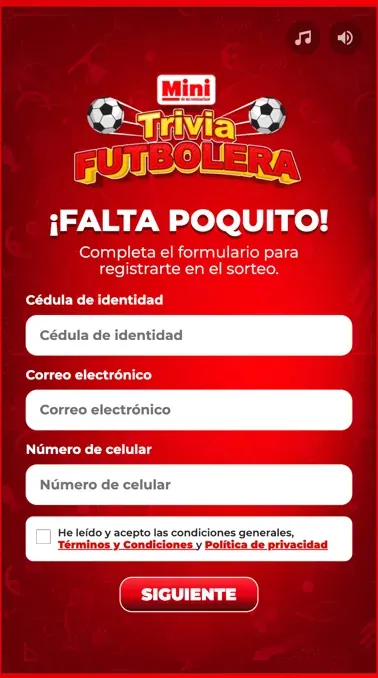
The registration process was intentionally simplified to maximize participation rates while maintaining the information required for validation and prize distribution.
Interactive Trivia Engine
At the heart of the platform was an interactive football trivia system designed to create a fast, engaging, and competitive experience.
Questions were dynamically delivered through the API while timers, scoring, and progression logic were managed in the frontend through reusable state-driven components.

Players progressed through multiple questions while receiving immediate visual feedback regarding correct and incorrect answers.
The experience included:
- Timed questions
- Dynamic answer validation
- Instant feedback
- Progressive game flow
- Mobile-optimized interactions
- Multi-stage campaign participation
Educational Feedback System
Rather than simply showing whether an answer was correct or incorrect, the platform provided contextual information after each question.
This transformed the experience from a simple giveaway mechanic into a more engaging educational game.
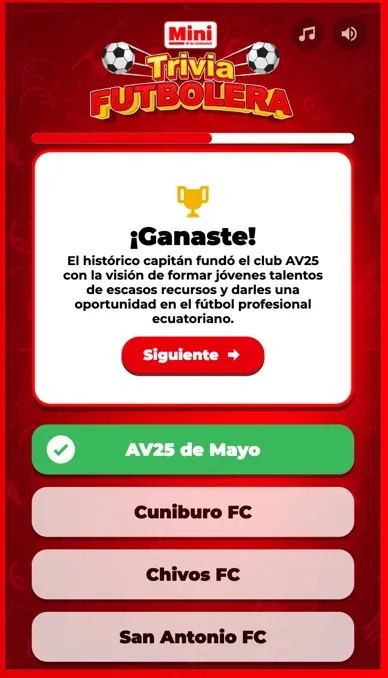

This approach increased user engagement while encouraging participants to continue interacting with the campaign.
Prize Participation Workflow
Successful participants earned entries into promotional prize draws.
The platform automatically tracked participation history, accumulated opportunities, and reward eligibility while preventing duplicate submissions and abuse.

The reward system included:
- Automated participation tracking
- Opportunity accumulation
- Prize eligibility validation
- Coupon management
- Duplicate prevention mechanisms
- Audit-friendly transaction history
The Engineering Problem: External Validation Bottlenecks
The most interesting technical challenge was membership validation.
The application depended on external membership systems that could respond slowly or become temporarily unavailable.
Performing these validations synchronously would have caused:
- Long loading times
- Request timeouts
- Poor user experience
- Increased server resource consumption
- Reduced campaign scalability
Instead of blocking the user while waiting for external responses, the platform implemented a queue-driven architecture using Laravel Jobs and Redis.
Queue-Based Processing Architecture
When a participant submitted their identification data, the system did not immediately perform the validation process.
Instead:
- The request was recorded.
- A validation job was dispatched to the queue.
- The API immediately returned a response.
- Background workers processed validations independently.
- The frontend periodically checked validation status.
- The user experience remained fluid regardless of external response times.
This architecture allowed the platform to handle high concurrency while isolating external system latency from the participant experience.
The result was a significantly more resilient and scalable system.
Frontend Architecture
The frontend was built using a screen-state architecture rather than relying heavily on route transitions.
This allowed the game to behave more like a native mobile application while maintaining the advantages of a web platform.
Key screens included:
- Registration
- Validation Processing
- Trivia Gameplay
- Success States
- Failure States
- Prize Qualification
- Participation Summary
This approach simplified state management while creating smoother transitions throughout the experience.
Backend Architecture
The backend was designed around clearly separated business processes.
Core modules included:
- Membership validation
- Trivia management
- Participant tracking
- Coupon distribution
- Campaign configuration
- Prize administration
- Audit logging
Redis and Laravel Horizon provided visibility into queue processing while ensuring background jobs remained reliable during periods of heavy traffic.
Technical Stack
The solution was built using:
- Nuxt 3
- Vue 3
- TypeScript
- Laravel
- Redis
- Laravel Horizon
- MySQL
- PostgreSQL
- Tailwind CSS
- DDEV
The architecture prioritized responsiveness, reliability, and operational scalability.
My Role
As Web Engineering Consultant and Full Stack Developer, I was responsible for both frontend and backend engineering decisions throughout the project.
My responsibilities included:
- Frontend architecture
- Backend API development
- Queue processing architecture
- Membership validation workflows
- Database design
- Campaign mechanics implementation
- Performance optimization
- Deployment support
- Operational troubleshooting
A significant portion of my work focused on designing asynchronous workflows that could safely interact with external systems while maintaining a seamless user experience.
Outcome
Trivia Futbolera successfully transformed a traditional promotional campaign into an interactive digital experience capable of supporting large participation volumes through modern web technologies and asynchronous backend processing.
The project demonstrated how queue-driven architectures can solve real-world scalability problems by isolating external dependencies from user-facing interactions.
Beyond the gamification mechanics themselves, the platform became a practical example of how thoughtful backend engineering can dramatically improve performance, reliability, and user experience under high-concurrency conditions.